Classes and Curriculum
Integrating AI into Business Education
At the College of Business, we integrate artificial intelligence into our curriculum where it adds meaningful value. Our goal isn’t to teach students to rely on tools like ChatGPT for answers. Instead, we focus on empowering them to use AI as a strategic resource. Whether in finance, research, or other disciplines, students learn to leverage AI to enhance decision-making, cut through information overload, and push the boundaries of their capabilities.
From Breakout Learning, an AI-platform moderating student small discussion groups for actionable insights and feedback, to generative AI tools such as Claude and Google Gemini, our students utilize artificial intelligence to support real-time decision-making and strategic analysis for event management, business and organizational strategies, cybersecurity, business operations and more.
AI is reshaping both how and what we teach, prompting curriculum updates as our faculty lead their disciplines in integrating AI tools and topics into instruction.
Explore to see what our students are studying across the various College of Business departments.
Business Communications
In the Department of Business Communications, students gain hands-on experience with AI through targeted coursework. In GEB3234: AI for Business Communications, students use tools like ChatGPT and Claude to prepare business messages, visual aids, and presentations tailored to workplace audiences. They also learn to analyze the ethical dimensions of AI-generated content, collaborate with peers to assess AI strategies, and leverage AI for job search and career readiness. In GEB3231: Business Communications for Data Analysts, students apply AI platforms o interpret complex data and communicate insights effectively.
Economics
The Economics Department is incorporating AI tools into its teaching and research to support data-driven learning and innovation. In courses like Economic Analytics and Big Data, students are introduced to AI-enhanced platforms such as RStudio with ChatGPT integration and tools like ChatPDF. Faculty are also using machine learning methods in research, exploring topics such as tax avoidance and spatial modeling, and involving students in independent studies that apply AI to economic analysis.
Finance
The Finance Department is integrating AI into its curriculum to prepare students for a
rapidly evolving financial industry. In FIN 4504 Investment Analysis, students complete a Connect AI Smart Book assignment focused
on ethical AI use and effective query formulation. AI tools are used to support portfolio
analysis, data gathering, and presentation development, helping students apply classroom
concepts to real-world tasks. Students also use AI to research financial trends and
build slides for presentations. To connect theory with practice, the Finance Student
Club recently hosted an industry leader from Bank of America, who shared insights on how AI is transforming financial services. These efforts
reflect a broader commitment to innovation, ethics, and industry alignment. 
Hospitality and Tourism Management
Students in the Hospitality and Tourism Management program learn how to improve operations, marketing, and management within the industry using real-world AI tools. In the Food & Beverage Management course, students explore platforms like Popmenu, which uses AI for marketing automation and phone answering, boosting restaurant sales and reducing labor costs. They also analyze PreciTaste, an AI-driven kitchen task management system that improves efficiency by reducing waste and increasing profitability. In the Event Management course, students evaluate a few AI-powered solutions for event planning, personalization, and data analytics, connecting these tools to improved event management outcomes. These hands-on applications help students understand how AI is transforming the guest experience and operational performance across the industry.
Information Technology and Operations Management
FAU’s ITOM department offers a robust curriculum integrating AI across undergraduate
and graduate levels. Courses like ISM 4421 (Artificial Intelligence and Digital Transformation for Business) and ISM 4425 (Business Product Development with AI) teach students how to manage AI projects and build AI-native applications using low-code/no-code
tools. At the graduate level, ISM 6427C and ISM 6426 focus on business innovation and managing AI product development,
while MAN 7926 prepares Ph.D. students for research on AI’s business impact. AI is
deeply embedded in coursework, with students using tools like ChatGPT, Copilot, Canva,
and Google NotebookLM for assignments, presentations, and data analysis. In ISM 6427C,
students build autograders, mental health AI services, and pilot LLMs for grading
and feedback generation. Undergraduate courses such as ISM 4133 and ISM 3011 teach
students to create career-relevant datasets and apply AI for structured problem-solving
and learning strategies. Cybersecurity classes like ISM 6328 explore AI in intrusion
detection and deepfake analysis. Across the curriculum, students gain hands-on experience
with generative AI, NLP, and visualization tools like Power BI and Tableau, preparing
them for real-world applications and careers in AI-enhanced business environments.
Management Programs
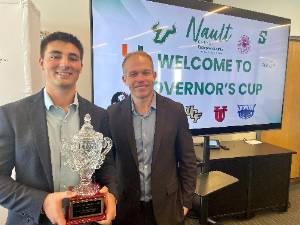
Students in the Management programs use AI tools to support strategic decision-making, enhance team-based projects, and strengthen critical thinking. In MAN 4720 Global Strategy and Policy, students use advanced AI language models to navigate simulations, interpret data, and explore business scenarios in real time. AI is also integrated into consulting projects like ENT 4934, where students use it to generate insights and recommendations for real businesses. In ENT 4024, AI supports ideation through interactive prompting, while MAN 3442 and MAN 3025 feature guest speakers with expertise in AI applications across sectors involving management. Assignments in MAN 4046, MAN 4610, and MAN 4320 include AI-powered simulations and team-based prompting exercises that emphasize analytical rigor and ethical use. Students must disclose the AI platform, prompts, and outputs to ensure transparency and academic integrity. Internship courses now include reflections on how students observe or use AI in the workplace. These efforts reflect a commitment to preparing students for AI-enhanced careers while maintaining depth of learning and critical engagement.
Marketing
Students in the Marketing programs use AI tools to elevate campaign development, enhance consumer insights, and refine strategic analysis. In MAR 3023 and MAR 4824, students apply AI to segment audiences, generate creative content, and simulate market responses. AI-powered platforms like Midjourney and ChatGPT support ideation and branding exercises, while tools such as Crayon and SEMrush are used to analyze competitor strategies and optimize digital marketing plans. In MAR 4403 Sales Management, students use AI to model customer interactions and improve sales forecasting. Guest speakers in MAR 4613 and MAR 4933 share real-world applications of AI in retail, hospitality, and entertainment marketing. Students in internship and capstone courses reflect on how AI is transforming customer engagement and marketing analytics in the workplace. These integrations ensure students are prepared to lead in a data-driven, AI-enhanced marketing landscape while maintaining creativity, ethical standards, and strategic depth.
MBA in Sport Management (Executive Education)
Analytics has long played a key role in sports, but AI is taking it to the next level—not replacing human intuition, but enhancing the decision-making of coaches and general managers to help their teams perform at the highest level.Students in the program gain firsthand insights from top executives of major sports organizations, learning how AI is being seamlessly integrated into professional decision-making. They also have access to a specialized course featuring an AI tool called PLAYERSONLYAI, which empowers them to explore player marketing, audience segmentation, and the monetary value of athletes’ social media presence.
School of Accounting
Faculty in the School of Accounting are actively exploring the role of AI in professional practice through class discussions and demonstrations. In ACG 6655 Advanced Auditing, students examine how audit firms and clients are integrating AI into audit planning, administration, and risk assessment. These discussions help students understand emerging tools and industry trends. In the tax research course, students are introduced to a specialized Tax AI program, showcasing how AI can streamline complex tax analysis. Faculty emphasize both the potential and limitations of AI, encouraging students to think critically about its role in financial decision-making. These efforts reflect a growing commitment to preparing students for AI-enhanced careers in accounting.
Degree and Certificate Tracks
MBA in Artificial Intelligence
Executive Certificate in Artificial Intelligence
Artificial Intelligence in Business Certificate