
OMHA Competency Model
Our comprehensive competency framework ensures graduates possess the critical skills necessary for healthcare leadership success.
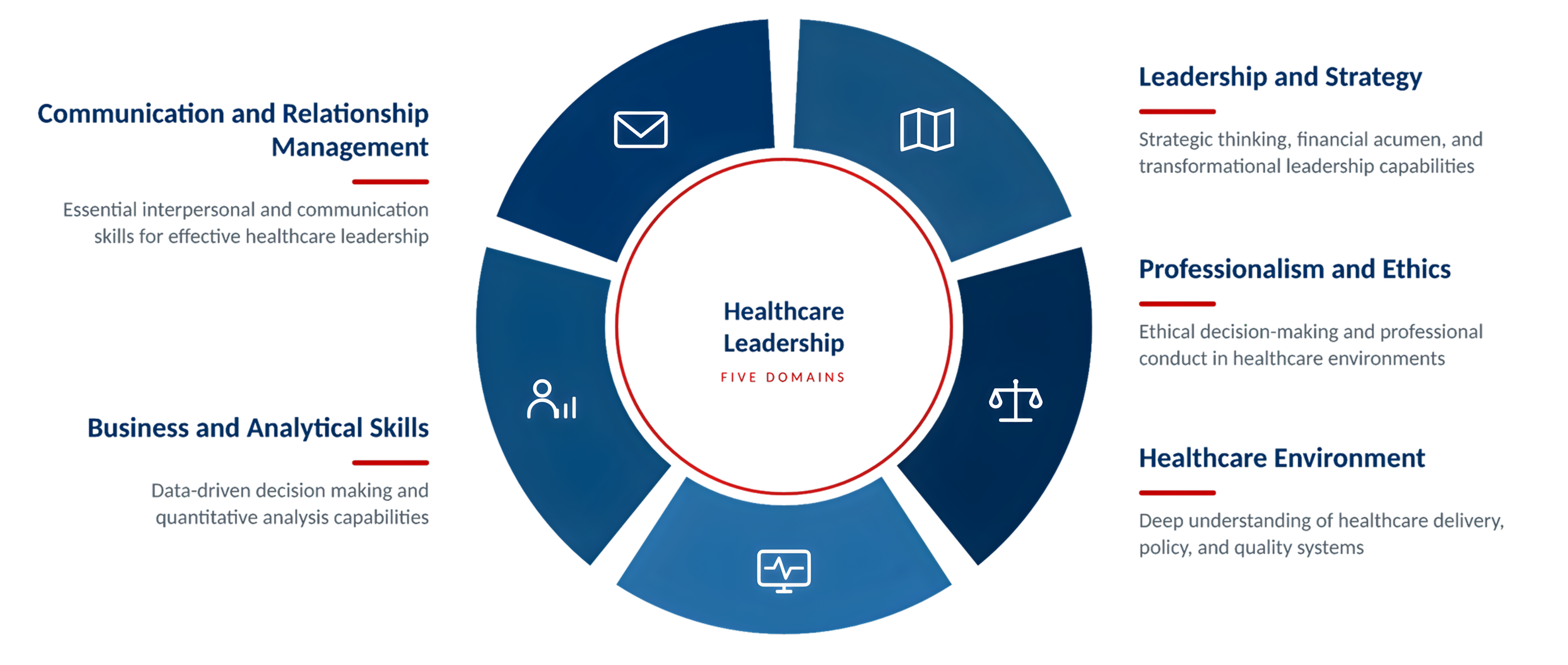
Download a copy of our MHA competency model framework here.
-
Domain 1: Communication and Relationship Management
Effective healthcare leadership requires sophisticated communication skills across diverse stakeholder groups. This domain ensures graduates can navigate complex interpersonal dynamics in healthcare settings.
Working in Teams - Importance of teamwork in a healthcare setting and design competencies to work effectively in different roles within a team. Students learn to leverage diverse perspectives and manage team dynamics in high-pressure healthcare environments.
Interpersonal Communication - Build collaborative relationships and develop negotiation skills, and showcase emotional intelligence. This includes conflict resolution, stakeholder management, and building trust across organizational levels.
Writing Skills - Prepare effective business communications for various healthcare audiences, from clinical staff to board members. Emphasis on clarity, persuasion, and professional documentation standards.
Presentation Skills - Demonstrate effective oral communication and presentation skills for leadership contexts. Students master techniques for engaging diverse audiences and communicating complex healthcare concepts clearly. -
Domain 2: Leadership and Strategy
Strategic leadership capabilities form the core of effective healthcare management. This domain develops financial acumen, strategic thinking, and emotional intelligence necessary for transformational healthcare leadership.
Financial Skills - Business and management knowledge, reimbursements, coding and billing expertise essential for healthcare operations.
Strategic Planning & Business Development - Assessing current environment, identifying goals, developing strategic plans, implementing initiatives, and regularly reviewing and revising plans for organizational success.
Business Process Improvement - Efficiency optimization, adapting to changing healthcare environments, and embracing disruptive technologies for operational excellence.
Emotional Intelligence - The capacity to be aware of, control, and express one's emotions, and to handle interpersonal relationships judiciously and empathetically in healthcare leadership contexts. -
Domain 3: Professionalism and Ethics
Ethical leadership serves as the foundation of trust in healthcare organizations. This domain ensures graduates can navigate complex ethical dilemmas while maintaining the highest standards of professional conduct.
Personal and Professional Ethics - Adhere to ethical business principles and exhibit ethical behaviors in all healthcare management decisions. This includes understanding compliance requirements, day-to-day regulations, and the moral obligations healthcare leaders face when managing resources that directly impact patient care and organizational integrity.
Ethical Leadership - Embrace ongoing learning and development to stay informed about current ethical standards, best practices, and emerging issues in healthcare management. Leaders must model ethical behavior and create organizational cultures that prioritize ethical decision-making at every level. -
Domain 4: Healthcare Environment
Deep understanding of healthcare systems, policy dynamics, and quality frameworks enables leaders to navigate the complex healthcare landscape effectively. This domain ensures comprehensive knowledge of industry fundamentals.
Delivery, Organization, and Financing of Health Services - Comprehensive understanding of how healthcare systems operate, from service delivery models to organizational structures and financing mechanisms that drive healthcare operations.
Policy and Economics Analysis - Creation, analysis, and understanding of social or other norms that formally or informally provide guidance for healthcare delivery, including economic factors that influence healthcare decisions and policy implementation.
Administrative Systems for Quality Management - Assess and improve healthcare quality initiatives, which directly affect patient satisfaction and value-based care models. Understanding reimbursement structures and their impact on quality outcomes is essential for modern healthcare leadership. -
Domain 5: Business and Analytical Skills
Data-driven decision making has become essential in modern healthcare management. This domain equips leaders with sophisticated analytical capabilities to address complex organizational challenges through evidence-based approaches. These analytical competencies enable healthcare leaders to transform complex data into actionable insights that drive organizational performance, improve patient outcomes, and optimize resource allocation in increasingly competitive healthcare markets.
Systems Thinking - Understanding interrelationships between and among constituent parts of healthcare organizations.
Data Analysis and Information Management - Leveraging data, information, technology, and supporting structures for strategic decision-making.
Quantitative Methods for Health Services - Economic, financial, statistical, and discipline-specific techniques for healthcare analysis and modeling.