
Online MBA in Artificial Intelligence
This innovative program is designed to equip business leaders with the knowledge and skills to thrive in today’s AI-driven economy. The revolution is AI. Make it your career to lead it. Florida Atlantic University’s MBA in AI program integrates advanced AI concepts into the MBA curriculum, preparing graduates to lead in a rapidly changing business landscape. Organizations increasingly expect employees to apply AI tools effectively, and this concentration ensures students are ready to meet that demand.
The MBA in AI prepares you to lead in an AI-driven economy—where competitive advantage
comes from translating emerging technologies into scalable business results. This
concentration brings advanced AI concepts into the MBA core, giving you the breadth
of a management degree and the depth to steward AI initiatives across functions.
Why MBA in AI at FAU
- Business-first approach: Master AI through the lens of product strategy, operations, marketing, finance, and economics—not just algorithms—so you can champion initiatives that matter to the business.
- Hands-on learning: Practice planning and governing AI projects, adapting commercial AI tools (including low-code/no-code), and producing reproducible, data-driven work.
- Cross-functional relevance: Electives span analytics, digital marketing, social & web data, accounting applications, economics, and finance—so you can tailor AI skills to your role and industry.
- Career-ready skills: Build capabilities in opportunity sizing, solution design, model deployment oversight, risk management, ethics, and change leadership.
The AI concentration is available to all MBA students enrolled in our Executive MBA, Professional MBA, and Online MBA programs.
MBA Program Information
Executive MBA - Weekends
- Every Third Saturday and Sunday, 8:00 AM - 3:15 PM
- 23 months (including semester breaks)
- GMAT/GRE exam scores are not required for qualified applicants
- Minimum 5 Years of professional and managerial experience recommended
- Full service, administrative support allows uninterrupted schedules
- Learn more about the Executive MBA
Professional MBA - Weeknights
- Tuesday & Thursday Evenings, 6:30 PM - 9:30 PM
- 23 months (including semester breaks)
- GMAT/GRE exam scores are not required for qualified applicants
- 4 Years of Work Experience Recommended
- Full service, administrative support allows uninterrupted schedules
- Learn more about the Professional MBA
Online MBA - Fully Online
- Fully Online MBA
- 16 - 23 months (including semester breaks)
- GMAT/GRE exam scores are not required for qualified applicants
- 4 Years of Work Experience Recommended
- Full service, administrative support allows uninterrupted schedules
- Learn more about the Online MBA
The Artificial Intelligence Concentration: Students electing the Artificial Intelligence concentration complete the basic MBA core courses plus four specialized courses. The concentration requires two mandatory courses. Additionally, students must select two courses from the list of electives below.
Two Required Courses:
Managing Artificial Intelligence Product Development (ISM 6426) 3 credits
This course introduces students to the practical methodologies of managing the development
cycle of artificial intelligence-based applications and services to enhance business
success. By managing, designing and developing AI-native as well as adapting commercial
applications that support low-code/no-code tools, the participants acquire the necessary
knowledge to explore opportunities for automation using AI and to acquire applied
knowledge of managing the AI product development and deployment.
Business Innovation with Artificial Intelligence (ISM 6427C) 3 credits
Students gain a business perspective of artificial intelligence (AI) and other emerging
technologies as drivers of innovation in businesses. They learn how AI is used in
practice across organizations and industries, how to plan, manage and maintain AI
projects, and how to address the AI challenges and implications for the organization
and society.
Elective Courses - select two
Advanced Accounting Applications of Data Analytics (ACG 6496) 3 credits
Data, data, data. It’s everywhere! Have you ever wondered how data analytics could
analyze REAL auditing, forensic accounting and financial statement issues? If so,
this is the class for you. Hands-on exercises combined with fundamental data concepts
to put you ahead of the game.
Introduction to Business Analytics and Big Data (ISM 6404) 3 credits
This course provides an understanding of the business intelligence and business analytics
processes and techniques used in transforming data to knowledge and value in organizations.
Students also develop skills in analyzing data using generally available tools, e.g.,
Excel.
Social Media and Web Analytics (ISM 6555) 3 credits
Covers concepts and techniques for retrieving, exploring, visualizing and analyzing
social network and social media data, website usage and clickstream data. Students
learn to use key metrics to assess goals and return on investment and perform social
network analysis to identify important social actors, subgroups and network properties
in social media.
Digital Marketing (MAR 6735) 3 credits
Applied exploration of digital marketing strategy and implementation, including website
design, search engine optimization, online advertising, web analytics, email marketing,
mobile marketing, social media marketing, content creation, and online reputation
management.
AI and Marketing – A Behavioral Science Perspective (MAR 6746) 3 credits
This course takes a behavioral science perspective, re. the impact of Artificial Intelligence
(AI) on Marketing. It identifies behavioral and managerial insights that might help
companies thrive in the age of AI. This is a non-technical course. No coding or data
science skills are required. This is also a hands-on course, requiring substantial
participation by way of creating custom GPTs, presentations on important AI-related
topics, development of a lifelong AI-learning plan etc.
AI and Machine Learning for Economics and Business Decision-Making (ECO 6445) 3 credits
This course explores how big data, artificial intelligence (AI), and machine learning
(ML) are transforming economics and business decision-making. Students will learn
how economics provides a framework for applying these tools in business decision-making
and policy analysis, while gaining hands-on experience with AI tools such as ChatGPT
and software like Stata to produce reproducible, project-based work. By the end of
the course, students will be prepared to apply economic reasoning and data-driven
tools to strengthen decision-making in today’s technology-driven business environment.
The course provides an overview of machine learning (ML) and artificial intelligence (AI) methods applied in the financial sector, particularly in the investment management and financial services industries with an emphasis on the role of these methods in investment strategies and portfolio management, risk management, and financial decision making.
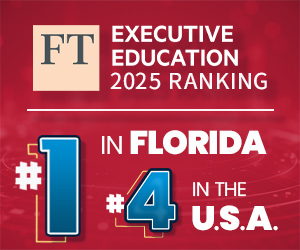
Executive Education Professional Development Programs
No. 1 in Florida and No. 4 in the U.S.
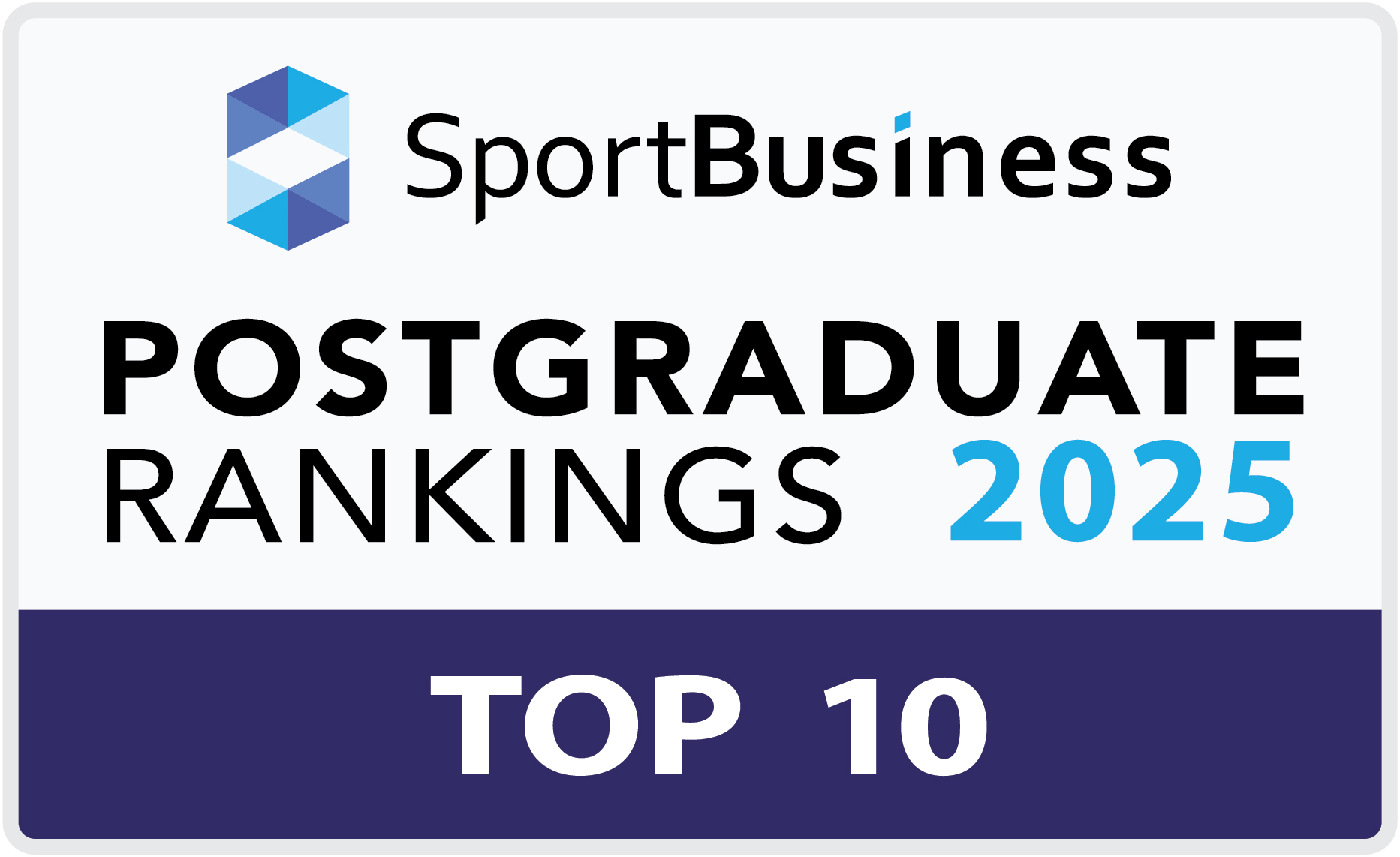
Best MBA in Sport Management
Top-10 in the world according to SportBusiness
Best Business Programs
Ranked among the best business programs
Best National Universities
Ranked among the best universities

R1 Distinction
Top-tier research university
Best Business Programs
Ranked among the best business programs
Best Graduate Schools in Business
Ranked among the best part-time MBA in business
Top-50 in Undergrad Entrepreneurship
Fifth consecutive ranking from The Princeton Review
Top-50 in Graduate Entrepreneurship
Fifth consecutive ranking from The Princeton Review
Best International Business
No. 23 undergrad. by U.S. News & World Report
Best Online Bachelor's in Business
Ranked among the best online bachelor's in business
ACTA Oases of Excellence
Phil Smith, Adams, and Madden Centers named ACTA Oases of Excellence
Best Part-Time MBA Program
Ranked among the best part-time MBA programs
Best Online Veteran MBA Program
Ranked among the best online veteran MBA programs
Best Online Graduate Program for Veterans in Business
Ranked among the best online graduate programs for veterans in business
Best Online MBA Program in Business
Ranked among the best online MBA programs in business